Fibronexa Fibronexa

What Is a DWDM Transceiver and How Does It Work?

Time:2026-09-25 Author:Amelia
0%

Digital networks carry video calls, cloud backups, and financial data across long fiber routes. Cisco’s Annual Internet Report (2018–2023) projected global IP traffic would reach 396 exabytes per month by 2022. That was up from 122 exabytes monthly in 2017. These figures describe IP traffic, not optical equipment sales. Still, they show why network operators need to move more data through existing fiber. The pressure is tangible: a single fiber strand must support many high-capacity connections. Every wavelength matters.

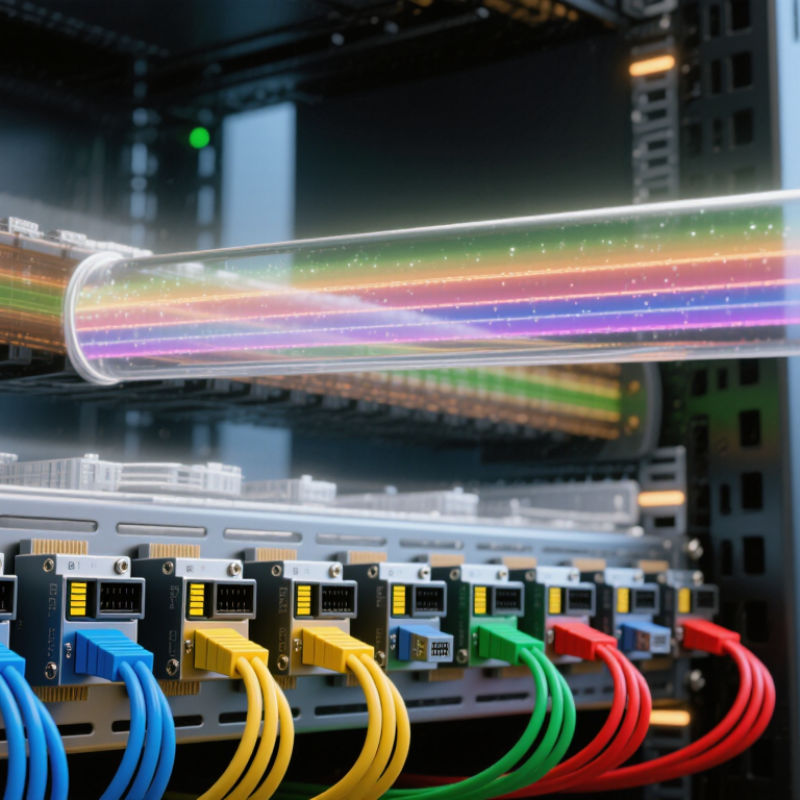
A DWDM transceiver helps make that possible by sending and receiving data on a specific optical wavelength. Dense wavelength division multiplexing combines multiple wavelengths onto one fiber, then separates them at the receiving end. Think of colored beams sharing a glass strand, each carrying its own stream of data. The transceiver converts electrical signals into optical signals and back again. Its reach, data rate, wavelength, and compatibility with network equipment all shape where it can be used. Some models use direct detection; coherent versions can support more demanding links. The terminology can feel less tidy in practice, because “DWDM transceiver” covers products with different designs and capabilities. Details matter. This guide explains how these modules work, what their specifications mean, and how they fit into real optical networks. It also considers a common trade-off: higher capacity can simplify fiber use, but planning, compatibility, and operating conditions still require careful attention.
What Is a DWDM Transceiver and How Does It Work?

What Is a DWDM Transceiver?

A DWDM transceiver is an optical module that converts electrical data into light and back again. It uses a carefully selected wavelength, or color of light, to carry a data channel through optical fiber. Dense wavelength division multiplexing places many closely spaced channels on the same fiber. A separate multiplexer combines those channels for transmission, while a demultiplexer separates them at the receiving end. That is its job.


Inside the module, a transmitter launches light at the assigned wavelength, and a receiver detects incoming optical signals. The equipment at each end must use compatible wavelengths and optical specifications. For example, a link’s reach depends on more than the transceiver: fiber loss, signal dispersion, and any optical amplification also matter. A clean connector helps, too; even a small amount of dust can weaken the signal.

In real deployments, the specifications can look simpler than the installation. Technicians may need to verify channel plans, optical power, and link errors before a connection works reliably. Not magic. And DWDM does not automatically increase the capacity of every existing link; the fiber path and supporting equipment still set practical limits. Some details are easy to overlook, especially when planning around older fiber.

What Components Make Up a DWDM Transceiver?

A DWDM transceiver combines electrical processing with optical transmission and reception. On the transmit side, a laser produces a stable wavelength, while a driver and modulator encode incoming data onto its light. A digital signal processor can handle equalization and forward error correction. On the receive side, a photodetector converts light into an electrical signal; a transimpedance amplifier strengthens it for processing. Heat matters. Small temperature changes can affect wavelength stability, so modules use thermal control and monitoring circuits.

Some systems also use optical multiplexers to combine many wavelengths onto one fiber. These are often separate from the transceiver, not built into it. ITU-T G.694.1 defines DWDM frequency grids, including 50 GHz channel spacing, helping engineers plan how closely channels can sit. The OIF 400ZR Implementation Agreement specifies a 400 Gb/s coherent interface, illustrating how much processing modern optical links may require. The exact component mix varies by reach, data rate, and module design. One detail is easy to overlook: a monitoring circuit reports conditions, but it cannot correct every fiber or connector problem. That distinction deserves attention.

How Does a DWDM Transceiver Send and Receive Data?

A DWDM transceiver sends data by turning an electrical signal into light at a carefully assigned wavelength. Inside the transmitter, a laser produces that light, while a modulator encodes the incoming bits as changes in the optical signal. A multiplexer then combines several wavelengths onto one fiber. Each channel travels like a separate lane, though all share the same glass strand. ITU-T Recommendation G.694.1 defines standardized DWDM frequency grids, including channel spacings of 50 GHz and narrower. Tight spacing allows more channels, but demands precise filtering and wavelength control. Small errors matter.

At the receiving end, a demultiplexer separates the wavelengths before each transceiver processes its assigned channel. A photodetector converts the arriving light back into an electrical signal. Coherent systems also measure the light’s phase and amplitude, then use digital signal processing to correct distortion accumulated along the route. The ITU’s Facts and Figures 2023 estimated that 5.4 billion people were online, underscoring the scale of connectivity networks must support. That figure does not measure optical traffic directly. Still, it helps explain why operators seek more capacity from existing fiber. One practical complication: longer routes and tighter channel spacing can increase signal impairment, so engineering margins deserve careful review. A diagram makes the path look effortless. Real links are less tidy.

How a DWDM Transceiver Sends and Receives Data

A DWDM transmitter encodes electrical data onto an optical carrier at a selected wavelength. At the far end, the receiver separates that wavelength and a photodetector converts the received light back into an electrical signal. This illustrative, normalized waveform shows the data pattern—not measured equipment performance.

How Are Wavelengths Used in DWDM Systems?

What Is a DWDM Transceiver and How Does It Work?

In a dense wavelength-division multiplexing (DWDM) system, each transceiver sends data using a specific wavelength of light. Think of wavelengths as separate lanes on one optical fiber. Their colors are too close for the human eye to distinguish, but the equipment keeps each channel precisely controlled. A multiplexer combines these signals for transmission, while a demultiplexer separates them at the receiving end. Many channels can travel together.

Channel spacing matters. Each wavelength must fit the system’s frequency plan, so neighboring signals do not interfere. The transceiver converts electrical data into light at its assigned wavelength, then converts incoming light back into electrical data. In practice, distance, fiber quality, and optical power also affect performance. Wavelength alone does not tell the whole story.

Tips: Check that the transceiver’s channel matches its multiplexer port and the far-end equipment. Keep fiber connectors clean; a small speck of dust can weaken the signal. Review optical power readings during installation. They are useful, though readings alone may not reveal every fault.

Where Are DWDM Transceivers Commonly Used?

DWDM transceivers are common in metro networks connecting data centers, internet exchanges, and carrier facilities. They let operators carry multiple optical wavelengths over the same fiber pair. A link between two buildings may use them to add capacity without installing new fiber. Distance matters. In long-haul networks, they connect cities and regional hubs, where signals travel through many kilometers of fiber and may need optical amplification.

They are also used in data center interconnects, submarine cable systems, and mobile transport networks. Data centers use them to move large volumes of traffic between sites; mobile operators use them to carry 5G traffic from cell sites toward the core network. TeleGeography’s 2024 Global Internet Geography report recorded 29% growth in international bandwidth in 2023, underscoring the pressure on backbone and subsea routes. DWDM can increase capacity on existing routes, but it is not automatically the best fit: equipment cost, fiber quality, reach, and traffic patterns all matter. A practical design starts with the actual link budget, not just the headline capacity.

FAQS

What components are inside a DWDM transceiver?

A laser creates light, while a driver and modulator encode data onto it. A receiver uses a photodetector and amplifier. Some modules also include digital processing and temperature monitoring.

How does a DWDM transceiver send data?

It converts electrical data into light at an assigned wavelength. The modulated light travels through fiber. Small errors matter.

How does it receive data?

A photodetector turns incoming light into an electrical signal. An amplifier strengthens that signal for processing. Coherent systems can also analyze light phase and amplitude.

How do multiple wavelengths share one fiber?

An optical multiplexer combines separate wavelengths onto one fiber. At the far end, a demultiplexer separates them. Each channel uses its own lane, so to speak.

Why does channel spacing matter?

Channels need enough separation to limit interference. Tighter spacing can carry more channels, but it requires precise wavelength control and filtering.

What affects wavelength stability?

Temperature changes can shift a laser’s wavelength. Modules use thermal controls and monitoring circuits to help maintain stability. Heat matters.

Does a monitoring circuit fix signal problems?

No. It reports conditions, but cannot correct every fiber or connector fault. A reading can look useful and still miss something.

What should I check when installing a transceiver?

Match its channel to the multiplexer port and far-end equipment. Clean the fiber connectors and review optical power readings. I may be overvaluing cleanliness, but dust can weaken a signal.

Conclusion

A DWDM transceiver is an optical module that enables high-capacity data transmission over fiber by using dense wavelength division multiplexing. It combines electronic and optical components, including a transmitter, receiver, laser, photodetector, and signal-processing circuitry. Together, these parts convert electrical data into light and prepare incoming optical signals for conversion back into electrical data.

When sending information, the transceiver encodes data onto a precise light wavelength and launches it into a fiber-optic link. At the receiving end, its photodetector detects the incoming light, and the electronics recover the data. DWDM systems assign different wavelengths to separate data streams, allowing many streams to travel through the same fiber at once. These transceivers are commonly used in telecommunications networks, data-center connections, and other long-distance links where high capacity and efficient use of fiber are important.

Amelia

Amelia

Amelia is a seasoned marketing professional with a wealth of expertise in our company’s core offerings. With an unwavering passion for driving growth and innovation, she plays a pivotal role in shaping our marketing strategies and enhancing brand visibility. A key aspect of her responsibilities......